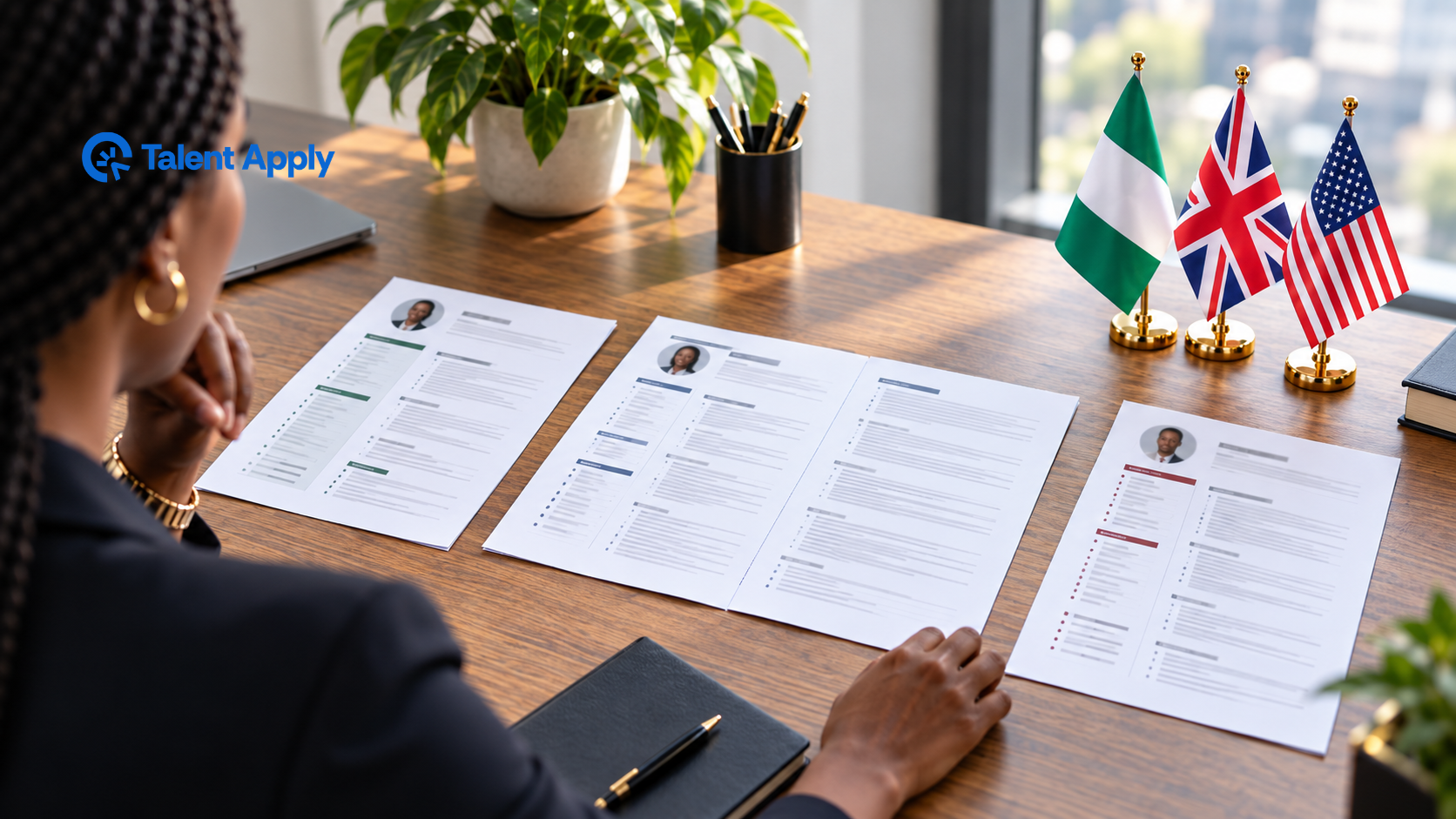
If you have ever tried applying for jobs outside Nigeria, you may have noticed something confusing: the CV rules you were taught at home do not always match what employers in other countries expect.
In Nigeria, you may have been told to include your date of birth, NYSC information, references and a fairly detailed work history. Then you apply for a job in the UK and discover that the advice is different. You apply to a US company and suddenly people are calling the document a "resume" and telling you to remove information you thought was completely normal.
Then there is the biggest question of all: how many pages should your CV actually be?
The answer depends on where you are applying, how much relevant experience you have and, importantly, what the employer has asked for.
There is no universal rule that says every CV must be one page or every experienced professional needs two pages. Current career guidance in Nigeria, the UK and the US shows some clear differences, but there is also quite a bit of overlap. The real goal is to make the document long enough to communicate your relevant experience and short enough that a recruiter can quickly find what matters.
So, if you are a Nigerian job seeker applying locally and internationally, here is how CV length generally works across the three markets.
The Short Answer
If you want the quick version, think about it this way:
|
Market |
Typical expectation |
What to remember |
|
Nigeria |
1–2 pages for many corporate roles |
Early-career candidates can usually stay around one page; experienced professionals may need two |
|
UK |
Around 2 A4 pages for most professionals |
One page is fine for graduates or people with limited experience |
|
US |
1 page is common for early-career candidates; 2 pages can be appropriate with substantial experience |
Follow the employer's instructions and focus heavily on relevant achievements |
These are conventions, not laws. A senior professional with 15 years of highly relevant experience may reasonably need more space than a fresh graduate, while someone with three years of experience may still have a very strong one-page resume.
The mistake is treating the page count as the main objective.
Your CV should not be two pages simply because you think two pages looks more professional. It should be two pages because the relevant information genuinely needs two pages.
How Long Should a CV Be in Nigeria?
The Nigerian market is probably the easiest place to get conflicting advice.
Some Nigerian employers still expect a fairly detailed CV, particularly in traditional industries and certain public-sector or professional environments. At the same time, current Nigerian career guidance increasingly recommends keeping corporate CVs concise, with one to two pages being a common range. For example, recent Nigerian guidance recommends one page for early-career candidates and around two pages once a candidate has several years of relevant experience.
That means a Nigerian graduate applying for an entry-level role does not need to submit a four-page document simply because they have been told that a "proper CV" should contain everything they have ever done.
If you have recently graduated and have only an internship, NYSC experience, a few projects and perhaps some volunteer work, one well-organised page may be enough.
For someone with several years of experience, two pages can make more sense because there is likely to be more relevant information to communicate.
The important word here is relevant.
If you have worked at six companies but only two of those roles relate closely to the position you are applying for, you do not necessarily need to give all six roles equal space.
What About NYSC?
For Nigerian applications, NYSC can still be relevant, particularly for graduates and early-career candidates. Depending on the role and employer, you may want to include your NYSC status or completion information, especially when an employer has specific eligibility requirements.
The key is to give it the amount of space it deserves.
If you completed NYSC five years ago and now have several years of professional experience, your career history should take priority over a long explanation of your service year.
What About Photos on Nigerian CVs?
This is another area where Nigerian and international conventions can differ.
Photos still appear on some Nigerian CVs and may be customary in certain sectors or application processes. However, current Nigerian career guidance is increasingly recommending that candidates leave photos off unless the employer specifically requests one or it is clearly customary for that particular role.
For international applications, especially to US employers, the expectation is generally different. Harvard's resume guidance, for example, advises candidates not to include a picture, age or gender on a standard US resume.
So if you are using one CV for both a Nigerian employer and a US company, do not assume that the same version will work equally well for both.
How Long Should a UK CV Be?
The UK is probably the clearest of the three when it comes to the two-page convention.
For most professional roles, two A4 pages is a common standard. UK career guidance from Reed says two pages is the typical length for most professionals, while Prospects recommends keeping a CV to no more than two A4 pages in most cases.
That does not mean every UK CV must be exactly two pages.
If you are a recent graduate with limited experience, one page can be perfectly reasonable. If you have a long career history, a second page may give you enough room to show relevant experience without cramming everything into tiny fonts.
The UK approach is therefore less about forcing every candidate into one exact length and more about keeping the document concise while giving enough room to demonstrate relevant experience.
Reed's recent guidance also notes that two pages was identified as the ideal length by 91% of recruiters in one of its surveys, although that should be understood as survey evidence rather than a universal hiring rule.
What Does a UK Recruiter Want to See?
A UK CV generally needs to make your experience easy to follow. Your employment history should usually appear in reverse chronological order, with your most recent role first, while the content should be tailored to the job.
The UK's National Careers Service recommends using clear formatting, headings and concise descriptions, and advises candidates to tailor their CV to each job rather than sending exactly the same document everywhere.
This means a two-page CV should not become an excuse to include every responsibility from every job you have ever had.
If the second page contains information that has little connection to the job, you have probably made the document longer than it needs to be.
How Long Should a US Resume Be?
This is where Nigerian job seekers often need to make the biggest adjustment.
In the US, the document is generally called a resume for most corporate and non-academic jobs. A resume is expected to be concise and focused on the experience and skills most relevant to the role.
For many early-career candidates, one page is the normal starting point.
Harvard's current guidance for master's candidates says a one-page resume is typical for BA/BS, MA/MS and MBA candidates, while two pages can be acceptable for people who are more advanced in their careers, have substantial experience or have a PhD.
Harvard also describes a resume as a concise summary of your abilities, education and experience, with an emphasis on making the document easy to scan and tailoring it to the role.
This is why you will often hear American career advisers say that a graduate or early-career professional should try to keep their resume to one page.
It is not because American recruiters have a magical ability to reject page two.
It is because the traditional US resume is designed to be highly selective. You are expected to choose the experiences, achievements and skills that are most relevant to the opportunity rather than providing a detailed history of everything you have done.
When Is Two Pages Acceptable in the US?
Two pages can make sense when you have enough relevant experience to justify the additional space.
For example, someone with 12 years of experience across several relevant positions may struggle to communicate their most important achievements on one page without using tiny fonts or removing useful information.
A technical specialist, senior manager, researcher or professional with substantial relevant projects may also have legitimate reasons for needing additional space.
The important thing is that page two should earn its place.
If page two exists because you refused to remove your secondary school information, every certification you have ever completed and five paragraphs describing an internship from 2017, the problem is not that your resume is too short. The problem is that it has not been edited enough.
Nigeria vs UK vs US: The Biggest Differences
The differences become easier to understand when you stop thinking only about page count.
The bigger issue is what each market generally expects you to put inside those pages.
Nigeria
For many Nigerian corporate applications, candidates may still encounter expectations around information such as NYSC status and, depending on the employer and sector, personal information that would be less common in international applications.
The market is also mixed, so the same approach may not work for a bank, a government role, a Nigerian startup and an international remote company.
For most corporate applications, however, a clean one- to two-page CV is a sensible starting point, particularly when your experience is presented clearly and the document is tailored to the role.
UK
The UK generally leans towards a two-page CV for experienced professionals. One page is still acceptable when there is less experience to show, particularly for graduates and early-career candidates.
The emphasis is on relevant experience, clear structure and concise information rather than creating a detailed record of your entire career.
US
The US generally places more emphasis on the concise resume format, particularly for students and early-career professionals. One page is commonly expected, while two pages become more reasonable as experience grows or where the employer or field allows it.
For US corporate applications, you should also be particularly careful about including personal details that are not normally part of a standard resume. Harvard's guidance specifically advises against including photos, age and gender.
What If You Are a Nigerian Applying to UK or US Jobs?
This is probably the most useful part of the whole conversation.
If you are sitting in Lagos, Abuja, Ibadan or anywhere else in Nigeria and applying for a job with a company in the UK or US, do not simply send the exact CV you use for Nigerian applications.
You need to consider the expectations of the market you are applying into.
For a UK application, a two-page CV may be completely normal if you have enough relevant experience. You should generally use the UK spelling conventions used in the role and make sure your location and work eligibility are clear where relevant.
For a US application, you will usually want a more concise resume, particularly if you are early in your career. Remove information that is not normally expected on a US resume, such as your photograph, date of birth, marital status or other personal details. Harvard's career guidance explicitly recommends leaving out pictures, age and gender from standard US resumes.
You should also be careful with terminology.
A Nigerian CV might say:
NYSC: Completed in 2023
For an international employer, you may need to provide enough context for them to understand what NYSC is and why it is relevant. You do not necessarily need a paragraph explaining it, but remember that the person reading your application may have never encountered the Nigerian system.
The same principle applies to Nigerian universities, local job titles, certifications and employers that may not be immediately recognisable to an international recruiter.
Should You Have Different CVs for Different Countries?
If you are seriously applying across multiple markets, having different versions can make your job search much easier.
You do not need to rewrite your entire career history every time you apply for a job. Instead, think of your CV as a master document from which you create targeted versions.
Your Nigerian version can reflect the conventions relevant to the local employers you are targeting.
Your UK version can follow the typical UK CV structure and length.
Your US version can be formatted as a concise resume with the information that American employers generally expect.
The content should still be truthful and consistent across all three. You are adapting the presentation, terminology and emphasis rather than creating three different versions of your career.
What If My CV Is Three Pages Long?
First, do not panic.
Three pages does not automatically mean your CV is bad. The question is why it is three pages.
If you have 15 years of highly relevant experience, multiple senior roles and achievements that genuinely need to be included, you may have a reasonable explanation for a longer document.
If you have three years of experience and your CV is three pages because each job has 15 bullet points, you probably have some editing to do.
Start by looking at every section and asking whether it helps demonstrate your suitability for the specific role.
Your primary school information probably does not need to be there. Neither does every training session you attended. A job you held ten years ago that has nothing to do with your current career probably does not need five bullet points.
The goal is not to make your CV shorter simply for the sake of being short. The goal is to make the important information easier to find.
Do Not Shrink the Font Just to Save a Page
This is one of the oldest CV tricks in the book.
You have a two-page CV, but you really want it to fit on one page, so you reduce the font from 11 to 8, make the margins tiny and squeeze everything together until the document looks like a legal contract.
Please don't.
A readable two-page CV is better than a one-page CV that requires the recruiter to zoom in.
Current UK guidance recommends readable fonts and warns against drastically changing font sizes or margins simply to force content onto fewer pages.
If the CV is too long, edit the content before you start fighting the margins.
Your CV Length Should Depend on Your Experience
Here is a more useful way to think about it:
|
Career stage |
Nigeria |
UK |
US |
|
Student/intern |
1 page |
1 page |
1 page |
|
Recent graduate |
1 page, sometimes 2 |
1–2 pages |
Usually 1 page |
|
3–5 years experience |
1–2 pages |
Around 2 pages |
1–2 pages depending on relevance |
|
5–10 years experience |
Around 2 pages |
Around 2 pages |
1–2 pages depending on experience |
|
Senior professional |
2 pages is common |
2 pages, sometimes more for specialist roles |
2 pages may be appropriate |
|
Academic/research role |
Can be longer |
Can be longer |
Full academic CV can be much longer |
These are practical guidelines rather than strict rules. The role, industry and employer can change the expectation, so always follow an explicit page limit in a job advert or application portal.
What About ATS?
You may have heard that your CV must be one page because Applicant Tracking Systems supposedly reject anything longer.
That is an oversimplification.
An ATS is software used by employers to help collect, organise and sometimes screen applications. The important thing is not simply the number of pages but whether your document is readable, appropriately structured and contains relevant information.
A two-page CV can still be ATS-friendly.
A one-page CV can still be terrible.
For an ATS-focused application, use clear section headings, standard job titles where appropriate and keywords that genuinely match the job description. Avoid filling your CV with keywords that you cannot support with actual experience.
UK career guidance also recommends standard headings and simple formatting for ATS compatibility.
How TalentApply Can Help
There is another part of the process that job seekers sometimes overlook: the CV you use should depend on the job you are applying for.
If you are applying to a Nigerian company, your CV may need to be presented differently from the version you send to a US-based remote employer. If you are applying for a marketing position, the achievements you highlight should also be different from the ones you would emphasise for a project management role.
This is where having access to more relevant job opportunities can help.
TalentApply helps job seekers discover jobs based on the type of role they are looking for, including opportunities from company career pages that they may not encounter through the usual job-board routine. You can also upload multiple CVs, which makes it easier to keep different versions for different roles or markets.
So instead of having one generic CV called Yetunde_CV_Final_Final2.pdf that you send to every company you see, you can have a more intentional approach. You might have a Nigerian corporate CV, a UK-focused CV and a US-style resume, alongside role-specific versions where necessary.
You can find and explore opportunities through TalentApply and use the type of job you are targeting to decide which version of your CV makes the most sense.
The Real Rule About CV Length
After all the debates about one page versus two pages, the simplest rule is this:
Your CV should be as long as it needs to be to show that you are relevant, and no longer than necessary.
For a Nigerian graduate with limited experience, that may mean one page.
For a mid-level Nigerian professional, it may mean two pages.
For a UK professional with several years of experience, two pages is a common expectation.
For a US graduate, one page is usually the safer starting point, while an experienced professional may reasonably use two.
The important thing is not to force your career into an arbitrary page count. Look at the market, understand what the employer expects, remove information that does not help your application and give the most relevant achievements the space they deserve.
And if you are applying internationally from Nigeria, remember that your CV is travelling with you. The fact that a certain format is normal here does not automatically mean it will be normal everywhere else.
Before you hit "Apply," take a minute to ask yourself: Is this the CV this particular employer expects to receive?
That question may be more useful than asking whether your CV is one page or two.